Essay
How the Nine Realms Emerged
Not from a branding exercise, but from the limits of smaller maps and the need for a larger architecture.
Intro
The Nine Realms did not begin as a neat idea.
It did not arrive as a tidy framework, a clean product ladder, or a clever branding concept.
It emerged because smaller maps kept failing.
They failed to explain what I was seeing.
Failed to explain what people were living.
Failed to explain why some methods worked in one place and broke in another.
Failed to explain why healing mattered so much and still was not enough on its own.
Failed to explain why real human change kept spilling across boundaries that most systems treated as separate.
That is where the architecture began.
Not in marketing.
In the failure of reduction.
The problem with fragments
For a long time, like many people in this field, I was working with pieces.
Useful pieces.
Real pieces.
Important pieces
Healing.
Identity.
Emotion.
Consciousness.
Transformation.
Practice.
Myth.
Strange experience.
Conditioning.
Challenge.
Each piece could reveal something.
But none of them, on their own, could hold the whole territory.
And the more seriously I looked, the clearer it became that a lot of the field was living on fragments and pretending they were wholes.
One discipline would claim the core answer.
Another would insist everything reduced to its preferred language.
Another would reject what it could not explain.
Another would romanticise what it could not structure.
That was not enough for me.
Why Sanomentology was necessary, but not sufficient
Sanomentology emerged because healing needed stronger structure.
That was not optional.
People needed real help.
Not theatre.
Not vague reassurance.
Not one more shallow intervention pretending to be profound.
So the healing work became serious.
Structured.
Deliberate.
But over time I kept running into the same truth:
Even when healing was central, it was not always the whole story.
Sometimes identity was the real engine.
Sometimes conditioning.
Sometimes the structure of the practitioner.
Sometimes challenge.
Sometimes the limits of consciousness models.
Sometimes the strange, barely-mapped edge-territories that conventional systems either mocked or worshipped without understanding.
That meant healing had to be placed inside something larger.
Not because healing was weak.
Because reality was larger.
The emergence of the Realms
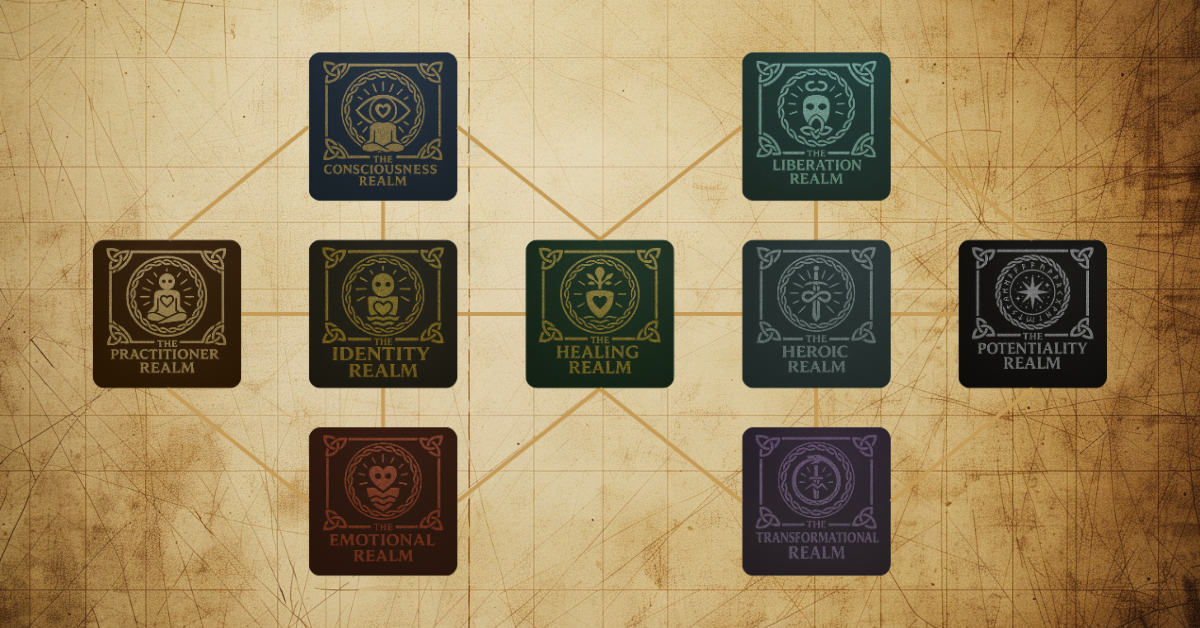
The Realms emerged as a way of naming recurring domains.
Not arbitrary categories.
Not aesthetic themes.
Domains that kept showing up in real work.
The practitioner.
Consciousness.
Identity.
Emotion.
Healing.
Liberation.
Heroism.
Transformation.
Potentiality.
Different layers.
Different questions.
Different kinds of difficulty.
Different kinds of change.
And the point was never that everyone needed all of them at once.
The point was that human beings kept arriving with problems that belonged in different places.
Once that became clear, the old confusion started breaking open.
You could stop forcing everything through one lens.
You could stop treating every issue as if it belonged to the same map.
You could start asking a better question:
Which Realm are we actually in?
Why the architecture mattered
Once the Realms became visible, something else happened.
The work became more honest.
Healing could be honoured without becoming the whole story.
Identity could be seen properly.
Transformation could be distinguished from intensity.
Liberation could be understood as something more than recovery.
Potentiality could be approached without collapsing into fantasy.
The practitioner could no longer hide behind technique alone.
The architecture did not make the work easier.
It made it truer.
And for me, truth mattered more than elegance.
Why the Nine Realms is one body of work
Over time it became obvious that these were not separate projects.
They were one body of work.
Sanomentology was the Healing Realm.
Other domains had their own integrity.
The wider architecture held them all.
That is why the Nine Realms matters now.
Not as a product stack.
Not as a mythic gimmick.
As the clearest map I could build for the territory I had spent years trying to understand honestly.
That is what people are meeting when they encounter it.
Not an idea I wanted to sell.
A structure I could no longer avoid naming.
Closing
The Nine Realms emerged because smaller maps kept breaking against reality.
That is the simplest truth.
Once you see that human beings are layered, that change happens across domains, that healing is vital but not sufficient, that identity, consciousness, transformation, conditioning, challenge, and potentiality all matter in different ways, the old one-layer systems stop being convincing.
You start needing something larger.
That is where the Nine Realms came from.
Not from a desire to create complexity for its own sake.
From the refusal to keep pretending smaller maps were enough.
THE NEXT STEP
If you want to understand the architecture that emerged from those failures, enter the Nine Realms.
That is where the map opens out fully.