Watch the Introduction Video
Start Here
This site describes a system of formation for changeworkers, therapists, and those entering deep human work.
It is not self-help.
It is not motivational training.
It is not designed to be consumed quickly.
If you are looking for reassurance, inspiration, or simple answers, this will not be a good fit.
This page exists to help you choose the correct entry point, not to persuade you.
This Work Is:
- Practitioner formation
- Protocol-based
- Psychologically grounded
- Ethically bounded
- Suitable for beginners and experienced practitioners
This Work Is Not:
- Motivational training
- Symptom chasing
- Manifestation or fantasy
- Identity inflation
- Fast or reassuring
If this feels restrictive, it is meant to be
How the system is organised
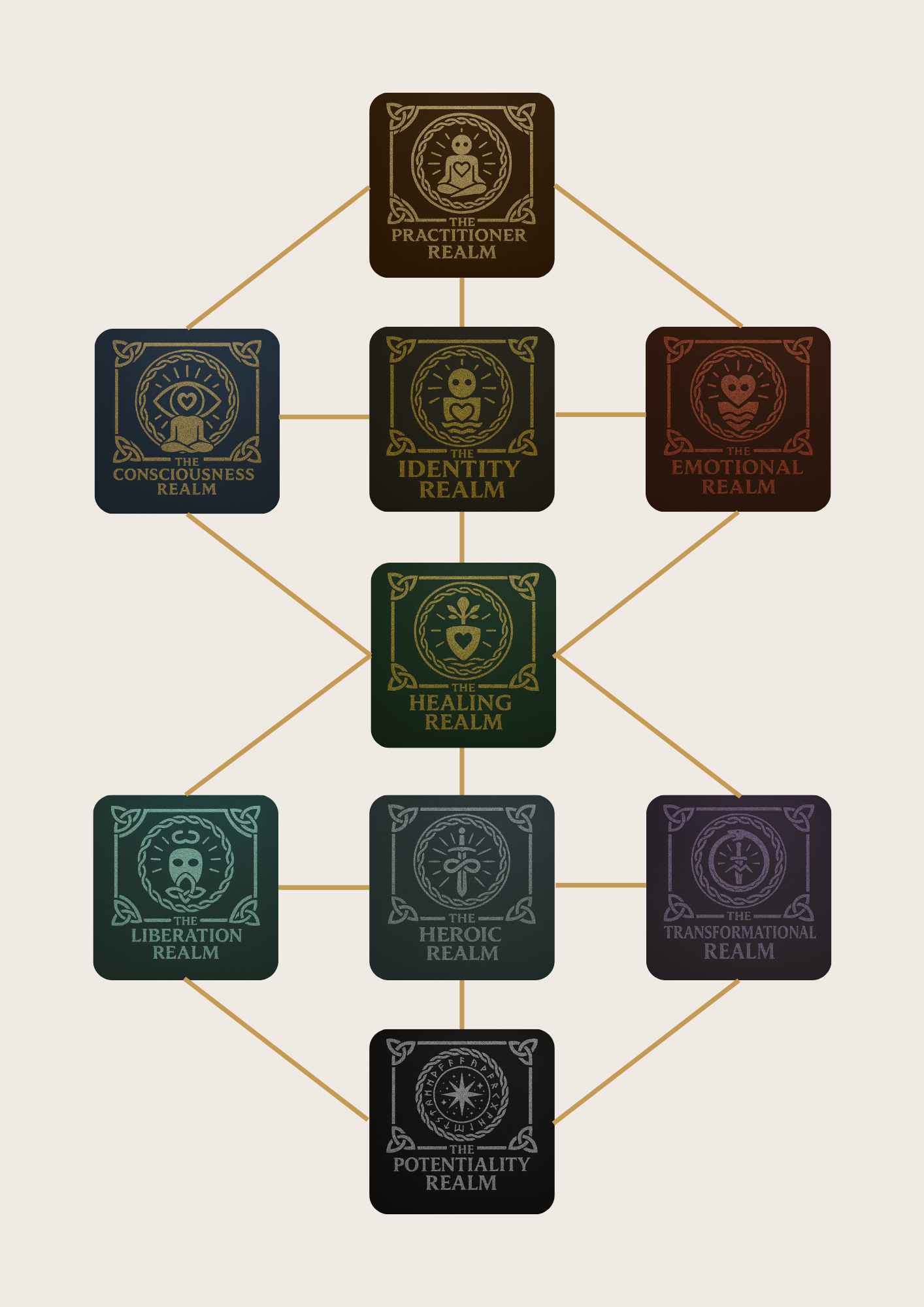
The work is organised into Realms and Integration.
- Realms are complete formation tracks, each focused on a specific domain of change.
- Boundless is an integrated formation for those working across multiple domains.
Each Realm stands on its own.
Boundless exists because coherence across realms requires integration.
This is not a ladder.
It is a system.
Click on a realm to explore more.

Enter Via a Realm
Enter a complete formation within a specific domain of changework — such as healing, identity, emotion, liberation, or potentiality.
Each Realm includes:
– Structured training
– Defined protocols
– Certification within scope
This is the most common entry point.
Enter Boundless
Boundless exists for those who already feel the limits of single-domain mastery.
It is not more content.
It is integration, coherence, and structural stability across domains.
If you already work across multiple realms, this may be the correct entry.
Certification & Authority
This system certifies practitioners within defined ethical and professional boundaries.
It does not replace licensure.
It does not grant universal authority.
Understanding this matters before entry.
If You Are Unsure Where to Begin…
Do not choose based on interest or excitement.
Choose based on constraint.
Ask yourself:
- Where does my current understanding fail to produce change?
- What do I consistently misread — in myself or in others?
- Which domain do I avoid, oversimplify, or over-control?
The Realm that answers those questions is usually the correct entry point.
Installment Plans are available on all courses.
Boundless Foundations
Realms 1–4: Become Client ZeroInstallments available: 10x £120
- Access to Realms 1–4: Practitioner, Consciousness, Identity, Emotional
Build a coherent inner base as Client Zero
Self-paced video curriculum with guided reflective exercises
Clear models of mind, identity and emotional signalling
Foundations certificate confirming competence in Realms 1–4
Suitable for serious students and early-stage practitioners
Credit this fee toward full Boundless within 6 months
Perfect if you’re serious about changework and want a real foundation instead of another technique.
Boundless Practitioner
Realms 5–8: Tools for Real Clients- Installments available: 20x £275
- Access to Realms 5–8: Healing, Liberation, Heroic, Transformational
- Learn Sanomentology for complex pain, anxiety and trauma work
- Structured protocols for liberation, heroic change and identity shifts
- Self-paced practitioner curriculum with case-focused assignments
- Practitioner certification within the Boundless system (Realms 5–8)
- Use methods with clients within your lawful scope and insurance
- Credit this fee toward full Boundless within 6 months
Ideal if you already work with clients and need a toolkit that holds up with real-world complexity.
Boundless Magic
Realm 9: Realm 9 Magic & Miracles- Installments available: 10x £320
- Access to Realm 9: Potentiality – Magic & Miracles
- 100-lesson curriculum on magic, miracles and potentiality
- Explore global traditions, psi skills and the “cosmic map”
- Treat magic as psychology we haven’t fully mapped yet
- Completion certificate for the Potentiality Realm training
- Ideal for spiritual-but-sceptical practitioners and explorers
- Credit this fee toward full Boundless within 6 months
For practitioners who are too magical for the rational crowd and too rational for the full-woo crowd.
Boundless: The Nine Realms
Full Path – Realms 1–9- Installments available: 20x £325
- Includes all 9 Realms: Foundations, Practitioner & Potentiality
- Lifetime access to the full Boundless architecture and updates
- All relevant certificates within the Boundless system
- Any previous bundle payments credited if you upgrade within 6 months
For those who know this entire world is theirs and are ready to walk the whole path.
Watch the Boundless Introduction
You do not need to decide everything now.
You only need to choose the correct place to begin.
Silence, structure, and restraint are part of the training