The Emotional Realm
Understanding emotion as a structural force that shapes perception, behaviour, and reality
The Emotional Realm trains a precise understanding of emotion not as feeling, but as an organising force within consciousness.
Most changework fails not because of lack of insight, but because emotional dynamics quietly override intention, belief, and behaviour.
This Realm exists to correct that.
It teaches how emotions arise, how they stabilise patterns, and how they distort perception — in self-work and in work with others.
This is not emotional expression.
It is emotional literacy.
*Includes Certification of Completion

Watch the Introduction
Who this Realm is for
- Practitioners who notice emotion overriding logic or intention
- Changeworkers working with trauma, resistance, or volatility
- Those frustrated by insight without follow-through
- Self-workers who repeat patterns they intellectually understand
- Anyone who wants precision instead of catharsis
Who this Realm is not for
- Those seeking emotional release as an end goal
- Those who equate emotion with authenticity
- Those avoiding structure or discipline
- Those looking for reassurance or validation
What you will be trained to understand
This Realm reframes emotion as a mechanism rather than a message.
Training focuses on how emotional states:
- organise perception
- stabilise identity
- maintain behavioural loops
- override conscious intention
Core areas of training include:
- The function of emotion within consciousness
- Emotional pattern formation and reinforcement
- The relationship between emotion, belief, and identity
- Why emotional insight alone rarely produces change
- How emotional states bias interpretation and memory
This understanding applies equally to self-work and client contexts.
Structure and Commitment
Work in the emotional domain requires patience and precision.
Emotions cannot be bypassed, argued with, or forcibly removed without creating secondary problems.
Structure includes:
- Structured lessons defining emotional mechanics
- Exercises to observe emotion without identification
- Applied reflection on lived emotional patterns
- Gradual recalibration of emotional response
Important:
This work often reveals contradictions between what is felt, believed, and enacted.
Lessons Include
- What Emotion Actually Is
- The Emotional Body
- The Three Emotional States
- Emotional Imprints
- Emotion as a Navigational System
- Emotional Tension and the Mechanics of Intention
- Emotional Resistance and Collapse
- Emotional Coherence
- Emotional Transmutation
- Integration: Living the Emotional Codex
Practice and Application
The Emotional Realm introduces disciplined practices to work with emotion rather than against it.
Practices are designed to:
- reduce emotional reactivity
- increase perceptual accuracy
- prevent emotional projection
- stabilise internal state under pressure
These practices are corrective, not expressive.
They prioritise clarity over catharsis.
Investment
This Realm is a complete formation within its domain.
Enrollment is a commitment to finish what you begin and to practice within ethical boundaries.
Investment: £400
Access: Online portal (instant access)
Format: Self-study Video Lessons with occasional live Zoom sessions
What is Included?
- Full online training lessons and materials
- Protocol guidance and best practices
- Certification upon completion (see below)
- Lifetime access
- Online Support
Certification for this Realm
Completion of the Emotional Realm grants Certification of Completion.
This confirms that you have completed the full formation requirements and engaged with the emotional model used throughout the system.
This certification:
- Recognises emotional literacy and structural understanding
- Signals reduced projection and improved practitioner stability
- Does not authorise client-facing practice on its own
Emotional competence supports practice — it does not replace authority.
Relationship to Boundless: The Nine Realms
This Realm gives you real capability.
Boundless: The Nine Realms gives you the full path – foundations, practitioner certifications, and the capstone Potentiality work in one coherent journey.
If you can already feel this work is more than “just another course,” explore the full Boundless path:
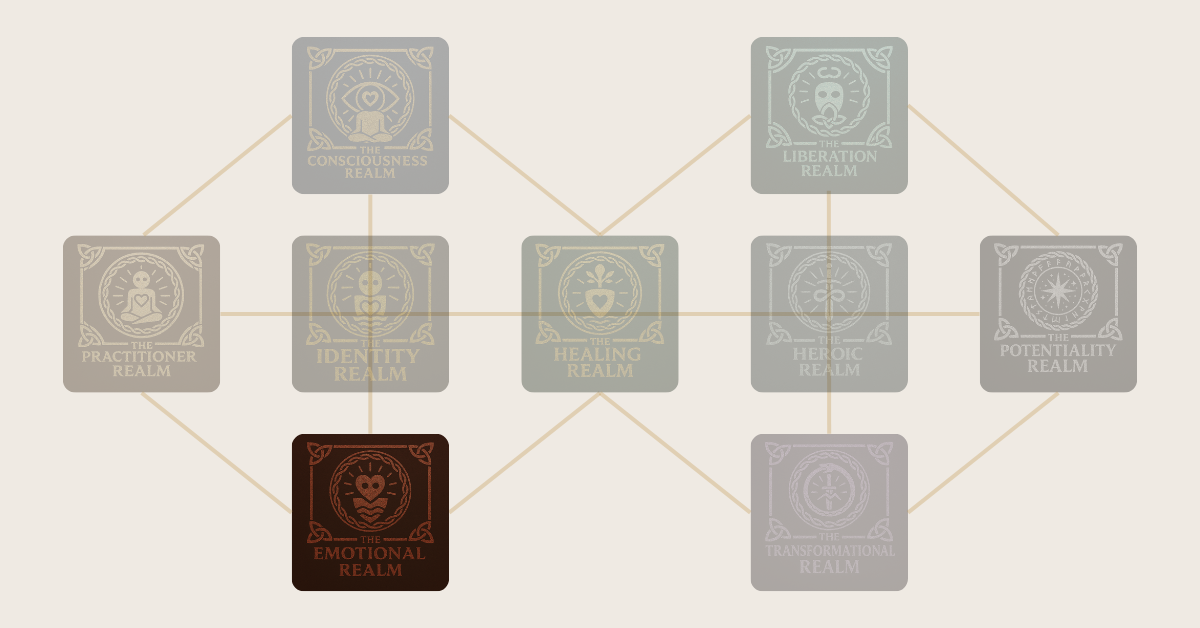
Enter the Emotional Realm
Enrollment signifies willingness to examine emotional patterns honestly, follow disciplined practices, and reduce reactivity rather than reinforce it.