Consciousness
What is the nature of consciousness? Does it belong entirely to the individual, or might it be part of something greater that we do not yet understand?


What continues when we're gone? What do our lives leave behind? And what does that mean for how we should live today?
The Continuance is an open, evolving philosophy I've developed through years of thinking about consciousness, human experience, responsibility and the things we pass on to others.
For nearly four decades, my work has involved helping people understand themselves, their behaviour, the choices they've made and what they might do differently.
Alongside that work, I've been interested in some rather larger questions. What is consciousness? Why do human beings search for meaning? How much do we really understand about existence?
And perhaps the most practical question of all: what happens to the world around us because we have lived in it?
The Continuance grew from those questions. I've written the philosophy and its founding books, but I don't expect my conclusions to be the final word.
I want other people to examine the ideas, argue with them, test them in their own lives and contribute to what The Continuance may eventually become.
Some concern what we believe about the world. Others concern what we actually do while we're here. The Continuance makes room for both.
What is the nature of consciousness? Does it belong entirely to the individual, or might it be part of something greater that we do not yet understand?
What gives a life meaning? Is it something we discover, something we create, or something that emerges through our relationships and actions?
What do we owe to one another? How do our decisions affect people we may never meet, including those who will live after us?
How much of who we are comes from other people? How do care, belonging and shared experience shape the lives we lead?
What can we reasonably believe about death? What continues through memory, influence and consequence? Might consciousness continue in ways we cannot yet explain?
Which parts of our thinking, culture, institutions and behaviour deserve to be carried forward? And which would future generations be better without?

The Continuance takes consciousness seriously, including the possibility that individual consciousness participates in something greater.
That possibility interests me. It is something I believe deserves serious examination. But I cannot claim to have proved what consciousness ultimately is, how it arises or what happens to it after death.
A powerful personal experience can carry great meaning. Its interpretation can still be mistaken. Scientific uncertainty doesn't automatically prove a preferred explanation.
Those distinctions are part of the philosophy. There is room for conviction, scepticism, hope and unanswered questions.
Explore the central ideas ↗However we understand consciousness and connection, we live among other people. Our decisions affect them. Their lives have value independent of what we want from them.
The Continuance places importance on personal agency, wellbeing, truth, responsibility, protection and repair.
It asks us to consider the effects of our actions, particularly when we have power over others or when somebody else is vulnerable.
It also recognises that forgiveness does not require reconciliation, that boundaries matter and that protecting somebody may be more important than preserving an appearance of harmony.
The principle invites serious consideration of how connected our lives are. It does not erase individual responsibility, consent or the right to protect yourself.
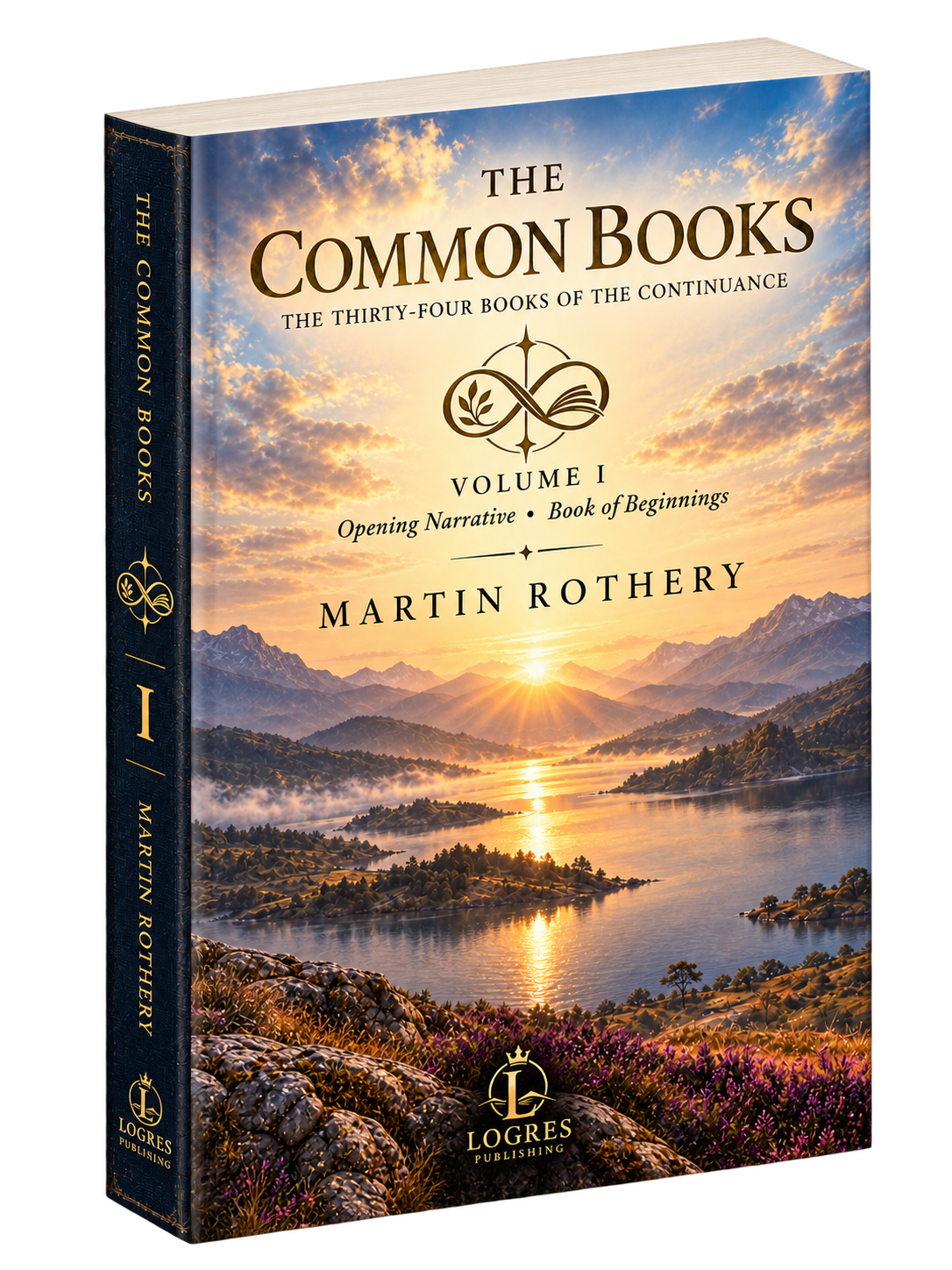
Read more about the philosophy →The Common Books are thirty-four works of imaginative literature, arranged across nine published volumes.
They contain creation stories, households, journeys, rulers, rebellion, war, ordinary work, love, loss, ageing, dying, disagreement and people who make mistakes.
The different books use different voices and literary forms. Some are expansive narratives. Others take the form of letters, songs, reflections or intimate accounts of individual lives.
The stories are intended to be read, questioned and argued with. A character can be mistaken. An ending can leave you uncertain. A book may challenge something you thought you understood.
I've written the Common Books as contemporary literature. The imagined histories within them belong to their fictional world.
The Continuance offers ways to bring its ideas into everyday life. People can practise privately, with others, or simply consider which parts are useful to them.
Taking time to notice what is happening, think carefully, examine a difficult choice or sit quietly with a question. Nobody has to manufacture a particular experience.
Helping somebody, keeping a promise, making a repair, taking responsibility for a mistake or using whatever influence we have with greater care.
Remembering the people who have shaped us, marking important moments, enjoying time together and recognising the ordinary pleasures of being alive.

I founded The Continuance and wrote its central works, but I want its future to involve people who are prepared to think, question and contribute.
People may read privately, discuss ideas, take part in shared practices, contribute their own thinking or simply remain interested observers.
The Continuance has its own developing community, membership and year-long programme of fifty-two weekly reflections and activities.
Belonging should remain voluntary. No one should have to adopt every idea, surrender their judgement or seek permission to leave.
Explore the community →You don't have to agree with The Continuance, read its books or join its community to use Living.
Living is concerned with examining your own life, circumstances and choices. The Continuance explores a wider philosophical account of consciousness, connection, meaning and responsibility.
Both grew from my interests and experience, but they serve different purposes.
Your Living membership, Stock Take, Life Work and Council consultations are separate from The Continuance. Private Living information is not automatically shared with its website or community.
If the philosophy interests you, you're welcome to explore it independently. If it doesn't, that makes no difference to your place in Living.
You can begin with a short introduction, explore the philosophy directly or start with its stories.
A free introduction explaining the central ideas, their limits and how the philosophy approaches evidence, experience and belief.
Read the free introduction ↗Explore consciousness, responsibility, connection, uncertainty and the ethical questions that shape the philosophy.
Explore the ideas ↗Discover the thirty-four literary works and their nine-volume arrangement. Begin at the beginning, or choose a subject that interests you.
Explore the books ↗The Continuance is a philosophy intended to grow through serious examination, contribution and human experience.
You're welcome to explore its separate website, read the free introduction, encounter the stories and decide whether anything speaks to the way you live.
We use essential cookies and, with your consent, analytics, marketing and affiliate tracking cookies. Privacy policy